
Nickel(II) Schiff Base Complexes: Molecular Structure and Coordination Chemistry
Nickel(II) Schiff Base Complexes: Molecular Structure and Coordination Chemistry
Exploring the molecular characteristics, metal–ligand interactions and research significance of a doubly deprotonated nitrogen–oxygen ligand complex.
Introduction
Nickel(II) coordination compounds are important research subjects in inorganic chemistry and molecular materials science. Their structural and electronic characteristics depend on the nature of the organic ligand and its interactions with the central metal ion.
The nickel(II) complex of 3-((2-(((2E,3Z)-4-hydroxy-4-phenylbut-3-en-2-ylidene)amino)ethyl)amino)-1-phenylbut-2-en-1-one, featuring a doubly deprotonated ligand, provides an interesting example of transition-metal coordination chemistry.
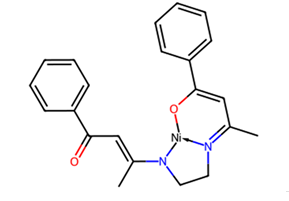
Chemical Information
| Compound | Nickel(II) Schiff Base Complex |
| Molecular Formula | C22H22N2NiO2 |
| Molecular Weight | 405.12 g/mol |
| Metal Center | Nickel(II) |
| Ligand Type | Doubly deprotonated Schiff base ligand |
Molecular Structure and Coordination
The molecular framework contains nitrogen and oxygen donor functionalities capable of participating in coordination with the nickel center. Ligand deprotonation modifies the electron distribution and contributes to the formation of metal–ligand bonds.
The aromatic phenyl groups and conjugated organic framework provide additional structural features that can influence molecular conformation and electronic properties.
Importance of Schiff Base Ligands
Schiff base ligands are widely studied because of their ability to coordinate transition metals through nitrogen and oxygen donor atoms. Their structural flexibility and electronic characteristics make them useful building blocks in the preparation of metal-organic coordination compounds.
Characterization Methods
FTIR Spectroscopy: Investigates characteristic functional groups and changes associated with coordination.
UV-Visible Spectroscopy: Studies electronic transitions in the metal complex.
Mass Spectrometry: Supports molecular mass and composition analysis.
X-Ray Crystallography: Determines molecular geometry and atomic arrangement.
NMR Spectroscopy: Provides structural information when the magnetic properties of the complex permit suitable measurements.
Research Applications
Nickel(II) Schiff base complexes are relevant to investigations in coordination chemistry, inorganic synthesis, molecular materials, spectroscopic analysis and structure–property relationships.
Further experimental studies are necessary to establish the specific physicochemical properties and potential functional applications of this particular compound.
Conclusion
This nickel(II) complex provides an interesting example of a transition-metal compound incorporating a doubly deprotonated nitrogen–oxygen Schiff base ligand. Its molecular composition and coordination framework make it relevant to research into metal–ligand interactions, molecular structure and inorganic chemistry.
Explore Chemical Research
Discover chemical compounds and research materials for your laboratory investigations.
EXPLORE PRODUCTS