
Dichloro(3a,6a-dimethyl-1,4-dihydropentalene)palladium(II)
Dichloro(3a,6a-dimethyl-1,4-dihydropentalene)palladium(II)
A palladium-based organometallic compound featuring a substituted dihydropentalene ligand, relevant to research in coordination chemistry and organometallic synthesis.
Product Overview
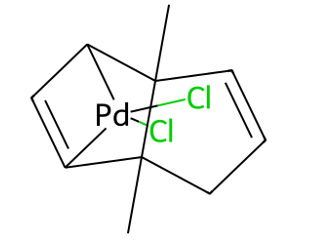
Dichloro(3a,6a-dimethyl-1,4-dihydropentalene)palladium(II) is an organometallic coordination compound containing a palladium(II) center, two chloride ligands, and a substituted dihydropentalene-based organic framework.
Palladium complexes are widely investigated in inorganic chemistry and organometallic research because of their diverse coordination behavior and ability to participate in metal-mediated chemical transformations. The dihydropentalene ligand provides an interesting structural framework for studying metal–ligand interactions and organometallic bonding.
Product Specifications
| Product Name | Dichloro(3a,6a-dimethyl-1,4-dihydropentalene)palladium(II) |
| Catalog Number | 1731-AQ ME 0012-01 |
| Size | 1 mg |
| Purity | 95% |
| Molecular Formula | C10H12Cl2Pd |
| Molecular Weight | 309.53 g/mol |
| Metal Center | Palladium(II) |
| Dry Ice | No |
| Hazardous | No |
| Shipping Conditions | Ambient temperature |
| Storage Conditions | Store tightly closed, dry, at room temperature, protected from light. |
Chemical Structure and Molecular Characteristics
The compound combines a palladium(II) metal center with two chloride ligands and a 3a,6a-dimethyl-substituted dihydropentalene framework. The fused cyclic organic structure contributes to the molecular architecture and provides a framework for investigating interactions between the organic ligand and the metal center.
The palladium–ligand coordination environment is relevant to studies of organometallic bonding, molecular geometry, and the structural behavior of palladium-based compounds.
SMILES
CC12CC=CC1(C)[CH]1C=[C]2[Pd]1([Cl])[Cl]
Palladium(II) in Organometallic Chemistry
Palladium(II) is an important oxidation state in organometallic and coordination chemistry. Palladium compounds are extensively studied for their ability to form bonds with organic ligands and participate in various metal-mediated transformations.
The coordination environment, ligand electronic properties, and molecular geometry all influence the behavior of individual palladium complexes.
Dihydropentalene Ligand Framework
Dihydropentalene derivatives contain a fused cyclic carbon framework with distinctive structural and electronic characteristics. Substitution at the 3a and 6a positions introduces additional structural features that can influence molecular conformation and the coordination environment.
Investigating these ligand systems helps researchers understand the relationship between organic ligand architecture and transition-metal coordination.
Research Applications
- Organometallic synthesis and coordination chemistry.
- Palladium–organic ligand interaction studies.
- Research into metal-mediated chemical transformations.
- Structural investigations of palladium complexes.
- Studies of cyclic carbon-based ligand systems.
- Development and characterization of organometallic compounds.
Analytical Characterization
FTIR Spectroscopy: Investigates characteristic vibrational features of the organic ligand and its coordination environment.
NMR Spectroscopy: Provides information about ligand structure and molecular environment, subject to the compound's spectroscopic properties.
Mass Spectrometry: Supports molecular mass and composition analysis.
UV-Visible Spectroscopy: Helps investigate electronic transitions within the palladium complex.
X-Ray Crystallography: Can establish molecular geometry, bond distances, and the coordination arrangement around palladium.
Shipping and Storage
Shipping: Shipped at ambient temperature.
Storage: Store tightly closed in a dry environment at room temperature and protect from light.
Research Use: For research use only. Not for human or veterinary use.
Related Products
Explore additional dihydropentalene derivatives and related research chemicals:
3a,6a-Dimethyl-2,5-diphenyl-1,4-dihydropentalene; 3a,6a-dimethyl-2,5-diphenyl-1,6-dihydropentalene
View Product →3a,6a-Dimethyl-1,4-dihydropentalene-2,5-dicarbonitrile; 3a,6a-dimethyl-1,6-dihydropentalene-2,5-dicarbonitrile
View Product →Dimethyl 3a,6a-dimethyl-3,6-dihydropentalene-1,4-dicarboxylate
View Product →3a,6a-Dimethyl-3,4-dihydropentalene-1,6-dicarbonitrile
View Product →3a,6a-Dimethyl-3,4-dihydropentalene-1,5-dicarbonitrile
View Product →3a,6a-Dimethyl-3,6-diphenyl-1,4-dihydropentalene
View Product →3a,6a-Dimethyl-3,6-dihydropentalene-1,4-dicarbonitrile
View Product →3a,6a-Dihydropentalene-1,4-dione
View Product →2,5-Bis(benzenesulfonyl)-3a,6a-dimethyl-1,4-dihydropentalene; corresponding 1,6-dihydropentalene derivative
View Product →3a,6a-Dimethyl-1,6-dihydropentalene-2,5-dicarbonitrile
View Product →Order Dichloro(3a,6a-dimethyl-1,4-dihydropentalene)palladium(II)
Discover specialized organometallic research chemicals through Gentaur.
LOGIN FOR PRICE24/48H Stock Items & 2 to 6 Weeks non Stock Items